
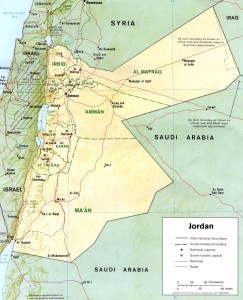
 Jordan is a highly literate and mainly stable country, with well-developed security and intelligence operations. But it has a fundamental vulnerability in the large number of Palestinians living in the country. Refugees arrived in large numbers from the West Bank and Jerusalem after the war in 1967, and more arrived from Kuwait after President Saddam Hussein of Iraq invaded that country in 1990. They and their descendants make up nearly half the country’s population which is currently estimated at 6.2 million. According to the USAID/Jordan Country Strategy for 2010–2014, Jordan is a “principal voice for moderation, peace and reform in the Middle East”. Its central geographic position – bordered by Iraq, Syria, the Palestinian Territories, Israel and Saudi Arabia– brings it into steady contact with regional turbulence that affects its political climate and its economy. In this volatile environment, Jordan remains a “model of stability and development progress in the region.” the strategy stated.
According to the Rule of Law Index 2011 report, issued by the World Justice Project, Jordan ranked second in the Middle East and the North Africa region but in spite of significant positive achievements, the country’s performance in terms of discrimination and labor rights “did not witness any progress and continued to worsen”. “The country’s efficient public institutions, along with a high level of security remain its main areas of strength. It also obtains relatively high marks in the areas of civil and criminal justice, absence of corruption, and effective regulatory enforcement,” said the report, which covered 66 countries worldwide. Jordan is keeping a good track record to promote the rule of law, but has much to do to further guarantee fundamental rights for its citizens, the report said.
In Economic terms, more than a decade, Jordan began the task of the complex implementation of the comprehensive structural reform; there was investment in education and infrastructure at the national level. Jordan concentrated on the regulatory reform in order to achieve growth led by a partnership between the public and private sectors. It has signed free trade agreements with the US, Canada, Europe, Turkey, Singapore and the Arab countries as a whole. A continuous striving to make improvements in all areas, starting with training on the skills of school-related needs of the labor market, more investment in infrastructure and the reduction of bureaucratic procedures that hinder.
Despite these achievements, Jordan faces hard and persistent challenges. The fundamental development challenge is a growing imbalance between scarce natural resources and the jobs and economic growth needed to fuel Jordan’s development and provide all Jordanians– including women, growing numbers of youth, and the urban poor– with opportunities to prosper and participate. The fundamental societal challenge is rising social conservatism and an associated “culture of shame”–cultural attitudes towards acceptable work for Jordanian women contribute to their low rates of participation in the workforce; unemployment among youth, poverty, and a dependence on third-country labor in many sectors of the economy, according to different reports concerned in Jordan Business.
Following the Arab Spring, there were extensive measures on constitutional and legislative changes that would enhance the separation of powers and protect the rights and civil liberties. The aim of these changes, along with other steps, to establish the fundamental elements of parliamentary government, a flourishing of political culture and political party exertion and rooting the values of democracy which are represented in the principles of accountability, transparency and the rule of law and others.
The current political situation
No one disagrees that Jordan is currently going through a critical, substantial and crucial phase in the core of an internal audit of the major political and economic issues, this review will establish a new era which can correct a lot of mistakes that were committed in the past years. This period of review begins now through several interpretations for the diagnosis of the reasons for the economic and political problems from the data, articles slogans and logos in the popular movement, which are all important contributions that must be framed within a system of careful analysis.
Recently, many issues are being raised in the country. There is talk about corruption, favouritism, failed institutions and about privatisation: whether it has been a success or a failure, whether it has led to wasting the resources of the country or increased them. There is also talk about taxes: are they fair or not? Have investment and openness to the private sector helped Jordan or not? In recent months, journalists, former generals and students have attacked corruption, lower subsidies and lack of democracy in Jordan, especially recent reductions in freedom of expression. The marchers have been a mix of Islamists, trade unionists and leftists.
The political situation in Jordan prior to the changes sweeping the Arab World since the beginning of the year can be evaluated as a state of unilateral decision making and discharge of authority, a state of political paralysis and a state of political emptiness. It has been believed by many experts that the real reason for this is the Parliament was not properly elected and does not represent the real interests of the people. It cannot undertake the role assigned it by the Constitution. The role of the National Assembly had been disrupted and the executive authority continued to dominate the legislative branch.
Corruption that resulted from the one-sided hold on power and decision making, a state of economic paralysis, the absence of economic and social development plans, no accountability for officials and difficult living conditions for impoverished people and for low-income people, who make up a large part of the society; all these issues made life difficult and caused people to protest and reform. The situation in Jordan is different from the ones in Tunisia, Egypt, Syria and Yemen. The revolutionary case in Jordan is not against the King; Jordanians need comprehensive reforms in their country to live in a democratic civil society with the principles of justice, equality, and respect for human rights and preservations of citizen’s dignity under the rule of law.
The case in Jordan can’t be transformed into a situation similar to the domino Tunisia-Egypt, the situation here is stable relatively because the social, political and security conditions are different from those, but there is similarity in the structure of social movements, popular protest. It is important to respond promptly and prudently with peaceful progress but in unwavering resistance to the letter of the new opposition and a shift from the wise policy of containment to a wisest policy of fundamental reform that achieve sustainable stability of the state and society.
On Tuesday, February 1st 2011 King Abdullah II fired his government after weeks of demonstrations, part of a wave of demands of public accountability sweeping the Arab world. The royal palace announced that the king had dismissed Prime Minister Samir Rifai and replaced him with Marouf al-Bakhit, who has served before in the post and is a former general and a onetime Ambassador to Israel and Turkey widely viewed as clean of corruption. Mr. Bakhit, served as prime minister from 2005 to 2007. He is close to the king and has been deeply involved in the peace treaty with Israel. It came after four weeks of unusual public demonstrations.
The palace statement said Mr. Bakhit would have the task of “taking practical, swift and tangible steps to launch a real political reform process, in line with the King’s version of comprehensive reform, modernization and development.” His predecessor was criticized as dealing primarily with technocrats and business leaders, while failing to consult with trade unions and the Muslim Brotherhood and to address the concerns of citizens. The reaction to the change of government was mixed. Many said they were relieved, but the Islamic Action Front, the political arm of the Muslim Brotherhood, rejected the move as insufficient given the need for greater political freedom. Zaki Saad, head of the Political Bureau of the Islamic Action Front, said Mr. Bakhit was “a very bad choice” and he was “not a man of dialogue.”
Given the structure of the Jordanian state, King Abdullah II has been the voice behind the vision of reform since his accession to the throne in 1999. However, even the King’s closest reform aides seem struck by the selection of the heads of government. “The decade long process, initiated by the King, has been largely ignored by a solidified layer of elites seeking to protect their own interests”, Jordan’s former Deputy Prime Minister and Minister of Foreign Affairs, and torchbearer for the Kingdom’s reform efforts, [Dr. Marwan Muasher] explained. Changing cabinets is not new for King Abdullah. In his 12 years on the throne, he has done so eight times. But this was the first time that he had done so in reaction to public pressure, seeking to destabilize a growing protest movement across a large range of society and to pre-empt further instability. The obvious contradiction between the King’s instructions to the eight prime ministers he had trusted to form governments in his 12 years of power–and the actual and tangible record of reform completed by these respective governments–points to a problem; could be a structural one!
On Sunday, February 20th 2011 King Abdullah II urged the three authorities; executive, legislative and judicial, to proceed with comprehensive reforms. He said that reform is an unwavering will and Jordan will promote openness, tolerance, pluralism and acceptance of constructive opinion as a firm and irreversible national course. The King said that “reform is our firm will and an interest of our people, which means development and keeping pace with the spirit of age”. He said he was waiting for the government to come up with recommendations on a mechanism for comprehensive national dialogue to tackle necessary steps to achieve political reform, at the top of which is studying and updating all legislations governing political and civic work, namely the elections law. The King urged the government and parliament to immediately investigate any corruption case and also urged the government to abide by the code of conduct which was based on the constitution and endorsed by the previous cabinet.
Since February till this moment, a quick reflection on government responsibilities and how to deal with a crisis shows that the present government of Marouf Al-Bakhit has failed in both areas insofar. Protesting continued till this moment, people don’t feel any change or any actual reform. The majority of protesters say that “we don’t want the king to go, but we want him to listen to us; we’re fed up with Al-Bakhit, with parliament and with Jordan being a police state ruled by the intelligence department.” Most of Jordanians have faith in the king but they believe that he is far away because of the corrupted bureaucrat layer of administrators and officials. During most of protesting movements, protesters were wavering banners that called for a “new Jordan, clean of corruption and corrupt officials.” “Intelligence department, we want your hands off politics!” they were repeating.
On Monday, 14th March 2011, the Cabinet decided to establish The National Dialogue Committee (NDC) to reach a consensus over political reform, headed by Mr. Taher Masri, the Senate President. The Committee created by the government to draft reforms on a limited set of laws had revolted, believing serious reform required a greater scope of action. They unilaterally chose to also tackle something much more contentious than laws about elections and political parties—they decided the Constitution had to be discussed. Unconvinced by NDC, Islamists took to the streets to voice their rejection of the committee and refused to be enrolled as members. The work of the NDC failed.
On Saturday, 21st May 2011, theFormer Prime Minister Ahmad Obeidat announced the launch of a pro-reform political coalition that includes opposition parties and unionists to call for the “rule of law” in Jordan.It is called the The National Front for Reform (NFR);its mission to see the country transformed into a truly democratic and civil country. Constitutional amendments, government accountability, combating corruption, new economic policies, redefining the role of security agencies, judicial reforms, press freedoms and revisiting the education system are the main cornerstones of the newly NFR, according to a statement released by the coalition.
Ahmad Obeidat was a Prime Minister in the 1980s and the director of the General Intelligence Department before that. In 1990 he chaired the National Charter Committee, which was appointed by the late King Hussein to create a master plan for Jordan’s political development. Then he was on a Royal Commission for Judicial Reform. Obeidat, who works as a lawyer now, is also from one of the most prominent tribes in the north of the country. Obeidat is a political heavyweight and widely respected. He’s also outspoken. When he announced the creation of the NFR, everyone knew this was something different than the previous announcements. He is among the candidates for heading the new government. He criticised the performance of the current government and said that the Prime Minister should resign. Besides he believes that the King should work on the reform seriously. Reading between the lines, Obeidat agreed with the king to rule the opposition movement for the purpose of absorbing the public’s anger due to his background as a public figure.
Four Jordanian political parties have formed a new coalition under the banner The Jordanian Salvation Assembly. According to AmmonNews, the newly formed coalition will hold a press conference on October 15th 2011, to announce its platform, programs and objectives. The coalition will be formed of the National Constitutional Party, the Islamic Centre Party, the United Jordanian Front, and Al Hayyat Party.
The last weeks justified the issuance of a royal decree approving the constitutional amendments as referred from the Senate and the Lower House of the Parliament; the Governments’ confirmation on holding Municipal elections by the end of this year; the Parliament exceptional session dissolved by the King which indicates strongly to Parliament dissolving and holding a new elections on next April; a new Senate Council is expected to be formulated due to the resignation of five member because of their dual citizenship. Institutional changes are expected to be announced soon, likely on the next week, on the directors of the Intelligence Department expected to be headed by Firas Shawki, the Public Security Department, and the Royal Court likely to be headed by O’on Khaswaneh. A new cabinet will be assigned.
Pro-reform protests are set to enter their 10th month on Friday, 7th October 2011 with demonstrations scheduled in cities across the Kingdom, including the first ever by an emerging political force, according to activists. Thousands of activists marched in downtown Amman in a pro-reform demonstration organized by a coalition of reform movements. The protestors chanted slogans against the Jordanian parliament and government, calling for their dismissal and discharging what they considering widespread and endemic corruption. Protestors also blasted the 2011 draft of the Anti-Corruption Commission bill which includes an Article that stipulates heavy fines on exposing corruption; chanting “a journalist pays thousands to expose the corrupt.”
A large placard was raised, entitled “Names of the Corruption Team” which included names of important Jordanian figures, according to a press release.
Jordan’s Gulf Cooperation Council (GCC) Membership
Jordan had first applied to the GCC for membership in the mid-1980s, when the resource-barren kingdom found itself unable to finance a multibillion foreign debt caused by military purchases to modernize its army. But the request by the late King Hussein, the father of Jordan’s ruler -King Abdullah II- was rejected, with no reason given. The GCC’s about-face now, however, appears to emphasize mounting Arab security concerns following the regional uprisings that have so far ousted the leaders of Tunisia and Egypt and brought the unrest to GCC member Bahrain. The island nation’s neighbors fear the threat to that country’s Sunni monarchy could endanger the kingdoms and emirates of the region. They have pulled together; railing against what they say is Iran’s fueling of Shiite unrest in the Arabian Peninsula. In those fears is a measure of political symbiosis that could provide the necessary impetus for Jordan’s membership in a club that currently also groups Kuwait, the United Arab Emirates, Oman and Qatar. “Jordan is in desperate need of the GCC’s umbrella to ease its economic hardships, while the GCC wants Jordan’s security and military expertise at a time of regional instability,” said Jordanian political analyst Labib Kamhawi. “If anything happens in any GCC country, like the unrest that engulfed Bahrain, Jordan cannot intervene militarily if it’s not a GCC member.” Membership in the GCC would offer an opportunity for financial support for Jordan, an energy poor nation that relies extensively on foreign investment, tourism and worker remittances for its revenue. The benefit for Jordan depends on the nature of the membership.
The Israeli-Palestinian Conflict
It remains a source of division and international instability. Today, the situation has reached to a critical point; people in the region reject the status quo in Israel’s continued building of settlements and the challenge of international law. Jordan believes that the best solution is the two-state solution, one of an independent Palestinian state, sovereign and viable State of Israel that is safe and accepted. This means making comprehensive negotiations, resolving the final status issues; the main borders, Jerusalem, refugees, settlements, and move quickly to reach a final agreement. The solution foreseeing Jordan as the substitution land for Palestine is extremely rejected in the country.
8th October 2011